Data Contracts for Power Users
This section provides a detailed, technical overview of the analytics model for data analysts and other power users. It covers data consistency, table structures, and performance patterns.
For a high-level introduction and ready-to-use queries, please see the Start Here guide and the Cookbook. For column-level definitions, see the Data Dictionary.
Overview & Onboarding
What’s in the box
The analytics model covers the following business domains:
- Reputation (Reviews): Captures and analyzes public reviews and their historical edits. Supports brand health and acquisition reporting.
- Facts:
fact_reviews,fact_review_versions
- Facts:
- Employee Recognition (Mentions): Detects employees mentioned in reviews and tracks manual review status.
- Fact:
fact_employee_mentions
- Fact:
- Messaging & Engagement: Measures guest-business interactions, message mix, and responsiveness.
- Facts:
fact_interactions,fact_messages
- Facts:
- Customer Retention: Quantifies saved revenue and visits attributed to outreach.
- Fact:
fact_customers_saved
- Fact:
- Transactions: Tracks point-of-sale transactions and individual transaction items for revenue and product analysis.
- Facts:
fact_transactions,fact_transaction_items
- Facts:
- Location Performance: Provides a daily summary of key metrics for each location, optimized for dashboards.
- Fact:
fact_location_daily_stats
- Fact:
Star Schema Map
| Subject Area | Fact(s) | Grain (One Row Is...) | Conformed Dimensions |
|---|---|---|---|
| Reputation | fact_reviews | One review (latest state) | DIM_DATES, DIM_LOCATIONS, Account, Brand, Platform |
| Reputation (versions) | fact_review_versions | One observed review version | DIM_DATES, DIM_LOCATIONS, Account, Brand, Platform |
| Employee Recognition | fact_employee_mentions | One employee mention | DIM_DATES, DIM_LOCATIONS, DIM_EMPLOYEES, Account, Brand |
| Messaging & Engagement | fact_interactions | One interaction (engagement) | DIM_DATES, DIM_LOCATIONS, Account, Brand |
fact_messages | One message | DIM_DATES, DIM_LOCATIONS, Account, Brand | |
| Customer Retention | fact_customers_saved | One saved customer profile | DIM_DATES, DIM_LOCATIONS, Account, Brand |
| Transactions | fact_transactions | One transaction | DIM_DATES, DIM_LOCATIONS, Account, Brand |
fact_transaction_items | One transaction line item | DIM_DATES, DIM_LOCATIONS, Account, Brand | |
| Location Daily Performance | fact_location_daily_stats | One (location, date) pair | DIM_DATES, DIM_LOCATIONS, Account, Brand |
Conformed Dimensions: Date, Location, Account, Brand, and Employee are shared across all relevant subject areas.
Customer Export Contract
Customer exports are daily point-in-time file drops from the same public ANALYTICS tables documented here. The standard freshness target is delivery within 24 hours of the scheduled run. Exports are scoped to the customer’s configured brands and locations and delivered to customer-specific S3 buckets.
For operational details, see Customer Exports.
Subject Area Details
Each section below provides a conceptual diagram and a sample query. For detailed table contracts, see the Facts and Dimensions sections.
Reputation & Reviews
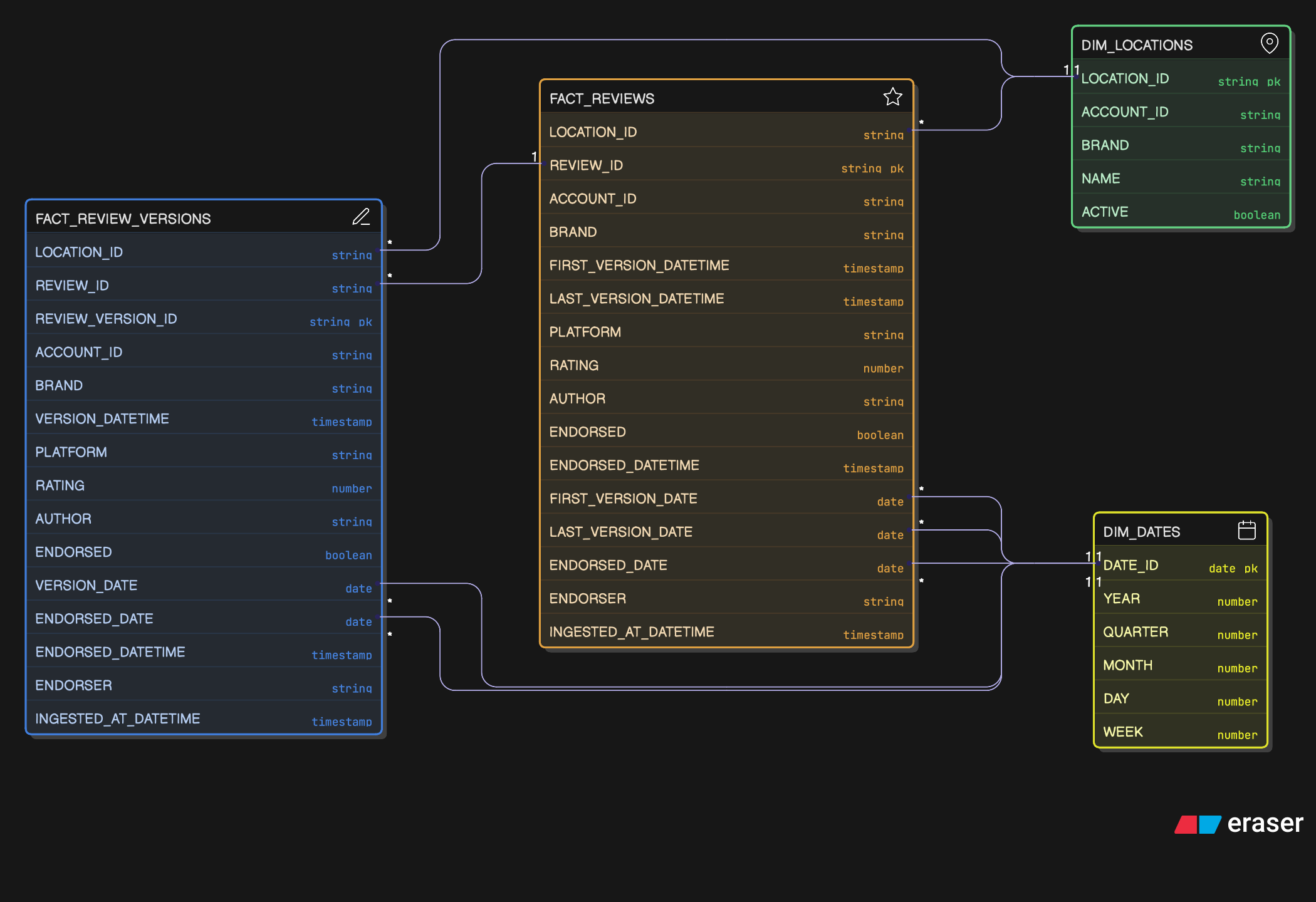
Sample Query: Monthly review volume & rating
SELECT
  l.brand,
  DATE_TRUNC('month', r.last_version_date) AS month,
  COUNT(*)                    AS reviews_count,
  AVG(r.rating)               AS avg_rating
FROM fact_reviews r
JOIN dim_locations l USING (location_id)
WHERE r.last_version_date >= :start_date AND r.last_version_date < :end_date
GROUP BY 1,2
ORDER BY 1,2;
Employee Recognition
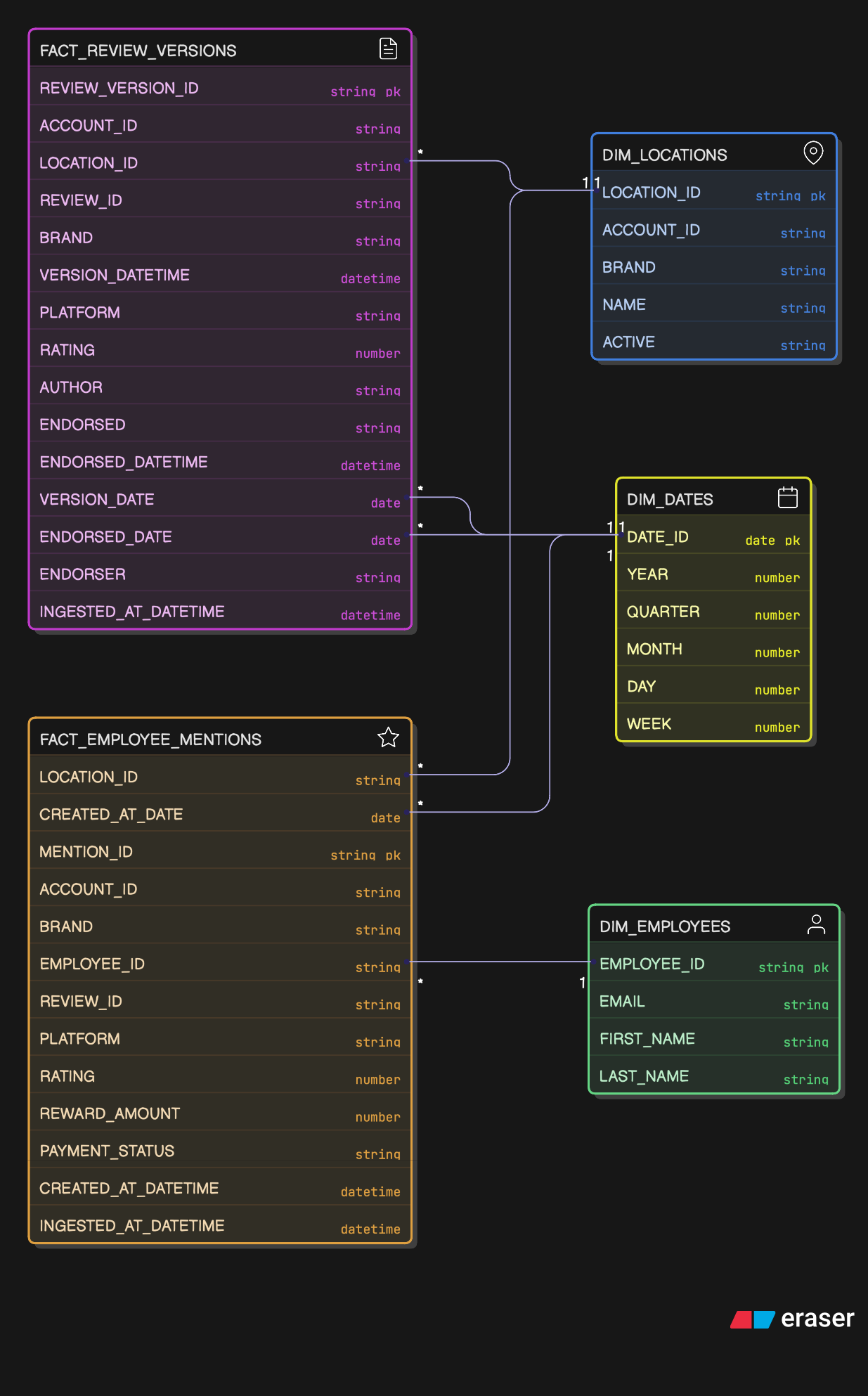
Sample Query: Monthly mentions
SELECT
  l.brand,
  DATE_TRUNC('month', em.created_at_date) AS month,
  COUNT(*) AS mentions
FROM fact_employee_mentions em
JOIN dim_locations l USING (location_id)
WHERE em.created_at_date >= :start_date AND em.created_at_date < :end_date
GROUP BY 1,2
ORDER BY 1,2;
Messaging & Engagement
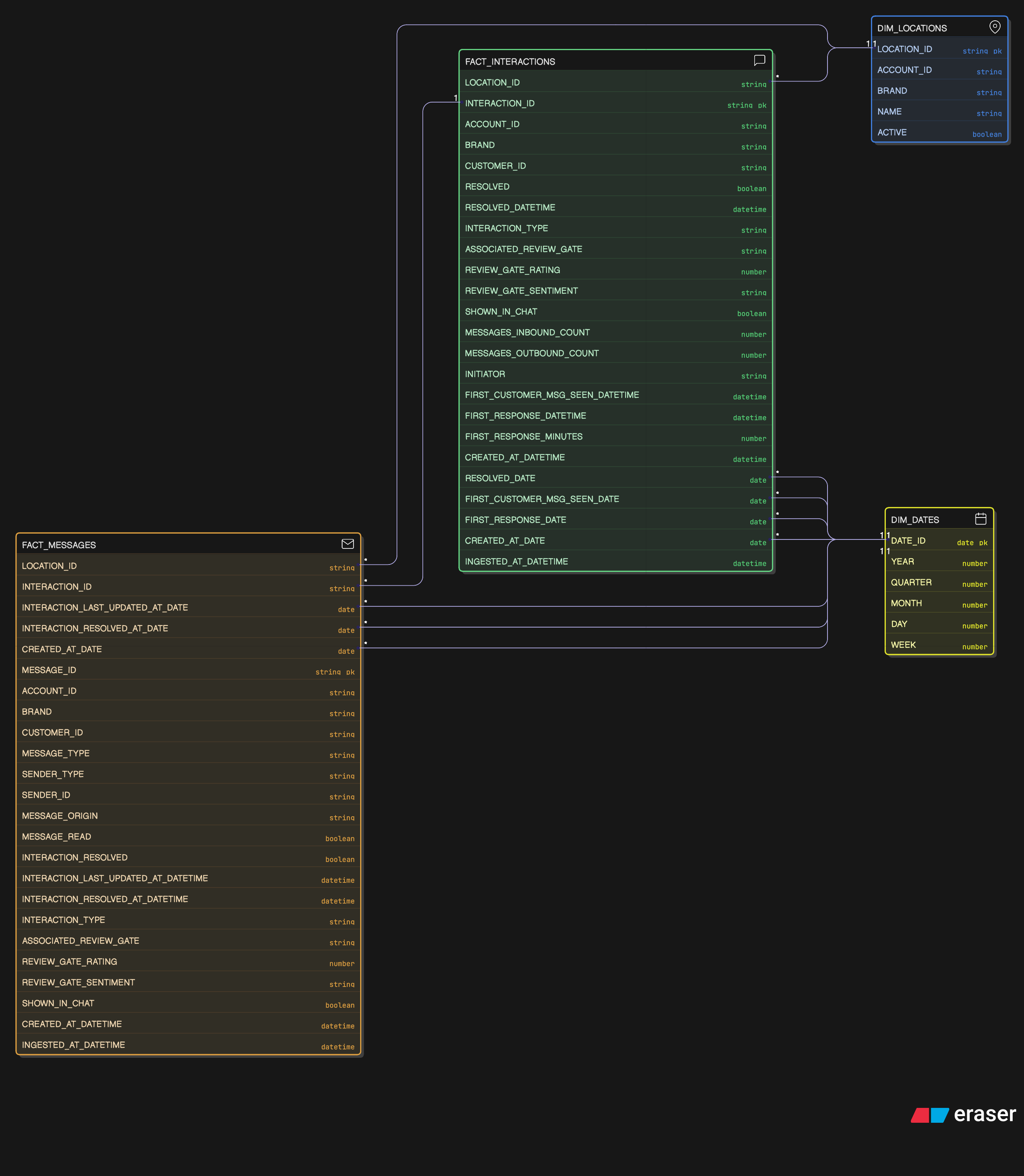
Sample Query: Average first response minutes by brand (last 30 days)
SELECT
  l.brand,
  AVG(i.first_response_minutes) AS avg_first_response_minutes
FROM fact_interactions i
JOIN dim_locations l USING (location_id)
WHERE i.created_at_date >= DATEADD('day', -30, CURRENT_DATE)
  AND i.first_response_minutes IS NOT NULL
GROUP BY 1
ORDER BY 1;
Customer Retention

Sample Query: Revenue from customers saved in the past 30 days
SELECT
  l.brand,
  DATE_TRUNC('month', cs.created_at_datetime) AS period,
  SUM(cs.saved_revenue) AS saved_revenue
FROM fact_customers_saved cs
JOIN dim_locations l USING (location_id)
WHERE cs.created_at_datetime >= DATEADD('day', -30, CURRENT_TIMESTAMP)
GROUP BY 1,2
ORDER BY 1,2;
Transactions
Sample Query: Total transaction revenue and item counts by brand (last 30 days)
SELECT
  l.brand,
  COUNT(DISTINCT t.transaction_id) AS transactions_count,
  SUM(t.transaction_item_count) AS total_items_sold,
  SUM(t.transaction_subtotal) AS total_revenue
FROM fact_transactions t
JOIN dim_locations l USING (location_id)
WHERE t.transaction_datetime >= DATEADD('day', -30, CURRENT_DATE)
GROUP BY 1
ORDER BY 1;
Sample Query: Top selling items by location (last 30 days)
SELECT
  ti.location_id,
  l.name AS location_name,
  ti.item_id,
  ti.item_product_type,
  SUM(ti.item_quantity) AS units_sold,
  SUM(ti.item_subtotal) AS revenue
FROM fact_transaction_items ti
JOIN dim_locations l USING (location_id)
WHERE ti.transaction_datetime >= DATEADD('day', -30, CURRENT_DATE)
GROUP BY 1,2,3,4
ORDER BY 1, revenue DESC;
Location Daily Performance
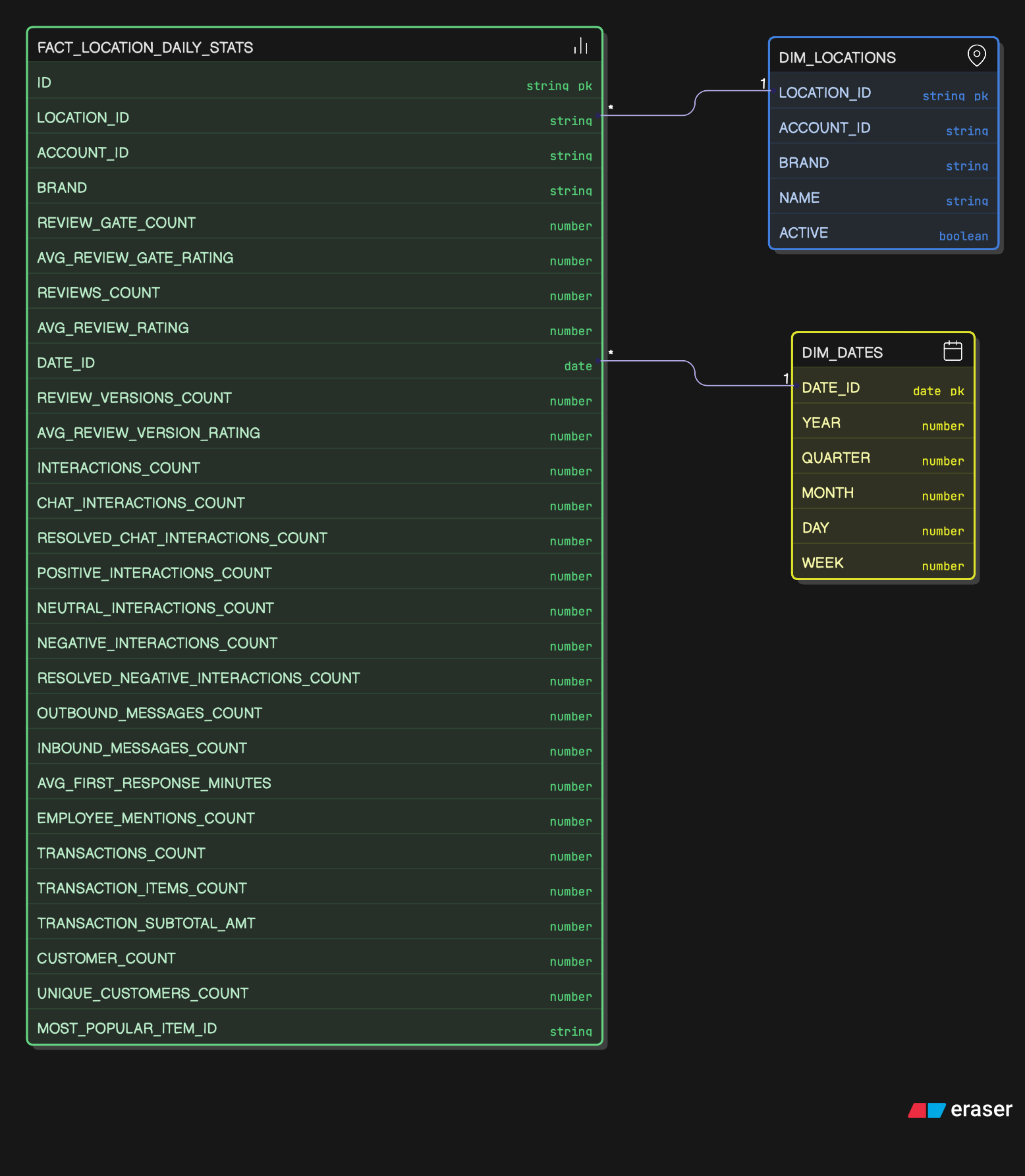
Sample Query: All-up daily dashboard feed
SELECT
  s.date_id,
  l.brand,
  s.reviews_count,
  s.avg_review_rating_all_time,
  s.interactions_count,
  s.positive_interactions_count,
  s.inbound_messages_count,
  s.outbound_messages_count,
  s.avg_first_response_minutes,
  s.employee_mentions_count,
  s.transactions_count,
  s.transaction_items_count,
  s.transaction_subtotal_amt,
  s.unique_customers_count
FROM fact_location_daily_stats s
JOIN dim_locations l USING (location_id, account_id)
WHERE s.date_id >= :start_date AND s.date_id < :end_date
ORDER BY 1,2;
Table Contracts: Facts
This section details the structure, grain, and change behavior of each fact table.
FACT_REVIEWS (Snapshot)
- Purpose: Latest state of each public review for KPI reporting.
- Grain: One row per review.
- Change Behavior: Mutable snapshot. Late edits upsert the row to reflect the latest state and also append a new record to
fact_review_versions. - Primary Key:
review_id(surrogate key) - Attributes:
location_id,account_id,brand,first_version_datetime,first_version_date,last_version_datetime,last_version_date,platform,rating,author,endorsed,endorsed_datetime,endorsed_date,endorser,ingested_at_datetime. - Notes: Use
last_version_datefor snapshot reporting andfirst_version_dateto track when the review first appeared.
FACT_REVIEW_VERSIONS (Append-Only Event History)
- Purpose: Authoritative history of review edits. Useful for tying back to employee mentions and measuring edit velocity.
- Grain: One row per observed review version.
- Change Behavior: Immutable, append-only table.
- Primary Key:
review_version_id(surrogate key) - Attributes:
location_id,account_id,brand,review_id,version_datetime,version_date,platform,rating,author,endorsed,endorsed_datetime,endorsed_date,endorser,ingested_at_datetime.
FACT_EMPLOYEE_MENTIONS (Snapshot)
- Purpose: Latest state of employee mentions within reviews, including whether manual review has been requested.
- Grain: One row per mention.
- Change Behavior: Mutable snapshot; values such as
employee_idandmanual_review_requestedcan be updated. - Primary Key:
mention_id(surrogate key) - Attributes:
location_id,account_id,brand,employee_id,review_id,platform,rating,manual_review_requested,created_at_datetime,created_at_date,ingested_at_datetime.
FACT_CUSTOMERS_SAVED (Snapshot)
- Purpose: Tracks revenue saved as a result of using Edge to save dissatisfied customers.
- Grain: One row per saved customer.
- Change Behavior: Mutable snapshot for adjustments to
saved_revenueandsaved_visits. - Primary Key:
customer_id(within the saved event context). - Attributes:
location_id,account_id,brand,saved_revenue,saved_visits,created_at_datetime,ingested_at_datetime.
FACT_INTERACTIONS (Snapshot)
- Purpose: Latest state of customer interactions for response SLAs and throughput.
- Grain: One row per interaction.
- Change Behavior: Mutable snapshot; message counts and resolution fields continue to update until the interaction closes.
- Primary Key:
interaction_id(surrogate key) - Attributes:
location_id,account_id,brand,customer_id,interaction_type,associated_review_gate,review_gate_rating,review_gate_sentiment,shown_in_chat,messages_inbound_count,messages_outbound_count,initiator,resolved,resolved_datetime,resolved_date,first_customer_msg_seen_datetime,first_customer_msg_seen_date,first_response_datetime,first_response_date,first_response_minutes,created_at_datetime,created_at_date,ingested_at_datetime.
FACT_MESSAGES (Message Snapshot)
- Purpose: Captures every individual message sent within an interaction for auditing, coaching, and SLA analytics.
- Grain: One row per message.
- Change Behavior: Mutable snapshot; rich data about the parent interaction is joined onto this row for convenience. As other messages affect the interaction, all other messages in the interaction update with the metadata.
- Primary Key:
message_id(surrogate key) - Attributes:
location_id,account_id,brand,interaction_id,customer_id,message_type,sender_type,sender_id,message_origin,message_read,interaction_resolved,interaction_last_updated_at_datetime,interaction_last_updated_at_date,interaction_resolved_at_datetime,interaction_resolved_at_date,interaction_type,associated_review_gate,review_gate_rating,review_gate_sentiment,shown_in_chat,created_at_datetime,created_at_date,ingested_at_datetime.
FACT_TRANSACTIONS (Snapshot)
- Purpose: Point-of-sale transaction data for revenue and customer behavior analysis.
- Grain: One row per transaction.
- Change Behavior: Snapshot table; rows are immutable once posted from POS.
- Primary Key:
transaction_id(surrogate key) - Attributes:
location_id,account_id,brand,customer_id,pos_transaction_id,transaction_datetime,transaction_date,pos,transaction_item_count,transaction_subtotal,ingested_at_datetime.
FACT_TRANSACTION_ITEMS (Snapshot)
- Purpose: Individual line items within transactions for product-level analytics.
- Grain: One row per transaction item (denormalized with transaction-level attributes).
- Change Behavior: Snapshot table; line items are immutable once posted.
- Primary Key:
transaction_item_id(surrogate key) - Foreign Key:
transaction_idlinks tofact_transactions. - Attributes:
transaction_id,location_id,account_id,brand,customer_id,pos_transaction_id,transaction_datetime,transaction_date,pos,transaction_item_count,transaction_subtotal,item_id,item_product_type,item_price,item_quantity,item_discount,item_subtotal,ingested_at_datetime. - Note: Transaction-level fields are denormalized into this table for efficient analytics without joins.
FACT_LOCATION_DAILY_STATS (Daily Aggregate)
- Purpose: Pre-aggregated location/day grain feed for dashboards and SLA monitoring.
- Grain: One row per
(location_id, date_id)pair. - Change Behavior: Mutable daily aggregate; counts are recomputed as upstream facts change.
- Primary Key:
id(surrogate key), with natural key(location_id, account_id, date_id). - Attributes:
brand,review_gate_count,avg_review_gate_rating,reviews_count,avg_review_rating_last_month,avg_review_rating_last_quarter,avg_review_rating_last_year,avg_review_rating_all_time,review_versions_count,avg_review_version_rating,interactions_count,chat_interactions_count,resolved_chat_interactions_count,positive_interactions_count,neutral_interactions_count,negative_interactions_count,resolved_negative_interactions_count,outbound_messages_count,inbound_messages_count,avg_first_response_minutes,employee_mentions_count,transactions_count,transaction_items_count,transaction_subtotal_amt,customer_count,unique_customers_count,most_popular_item_id,ingested_at_datetime. - Rating Columns: The four
avg_review_rating_*columns are weighted cumulative averages combining the pre-Edge baseline (fromgoogle_rating_pre_go_liveor computed historical average) with post-Edge reviews over rolling windows: last 30 days, last 90 days, last 365 days, and all time.
Table Contracts: Dimensions
This section details the structure and change behavior of each dimension table.
DIM_DATES
- Purpose: Shared calendar table for all time-based analysis.
- Grain: One row per calendar date.
- Change Behavior: Static (SCD-0). The table is auto-extended monthly.
- Primary Key:
date_id - Key Attributes:
year,quarter,month,day,week,day_name_short,day_name,month_name_short,month_name,is_weekend.
DIM_LOCATIONS
- Purpose: Canonical data for locations and their attributes (brand, region, eligibility program settings, and lifecycle stats).
- Grain: One row per location.
- Change Behavior: SCD-1. Changes to attributes overwrite previous values.
- Primary Key:
location_id(surrogate key) - Attributes:
account_id,brand,name,active,industry,internal,us_region_4,us_region_9,state,country,lat,lon,timezone,pos_name,employee_count,first_msg,last_msg,first_review,last_review,review_count_before_edge,review_count_after_edge,review_version_count_after_edge,endorser_program,eligible,payback,threshold,cap,shared_cap,split_payment,payment_program,digital_checks,go_live_datetime,go_live_date,created_at_datetime,created_at_date,ingested_at_datetime,google_reviews_pre_go_live,google_rating_pre_go_live.
DIM_EMPLOYEES
- Purpose: Directory for employees referenced in mentions and recognition reporting.
- Grain: One row per employee.
- Change Behavior: SCD-1.
- Primary Key:
employee_id(surrogate key) - Attributes:
email,first_name,last_name,ingested_at_datetime.
Performance & Query Patterns
Multi-Fact Query Pattern
The Problem: Joining two or more fact tables directly at the event grain can cause fanout, double-counting, and slow performance.
The Solution: The safe pattern is to aggregate each fact to the same grain first (usually (date_id, location_id)) in separate Common Table Expressions (CTEs), then join the aggregated CTEs on that shared spine.
Click to view the runnable spine-and-CTE template
-- PARAMETERS
-- :start_date :: DATE
-- :end_date   :: DATE

WITH
-- 1. Define the spine for your query
spine AS (
  SELECT d.date_id, l.location_id
  FROM dim_dates d
  JOIN dim_locations l ON 1=1
  WHERE d.date_id BETWEEN :start_date AND :end_date
),

-- 2. Aggregate each fact to the spine's grain
reviews_daily AS (
  SELECT
    fr.last_version_date AS date_id,
    fr.location_id,
    COUNT(*) AS reviews_count,
    AVG(fr.rating) AS avg_rating
  FROM fact_reviews fr
  WHERE fr.last_version_date BETWEEN :start_date AND :end_date
  GROUP BY 1,2
),

messages_daily AS (
  SELECT
    fm.created_at_date AS date_id,
    fm.location_id,
    SUM(CASE WHEN fm.sender_type = 'CUSTOMER' THEN 1 ELSE 0 END) AS inbound_messages,
    SUM(CASE WHEN fm.sender_type = 'LOCATION' THEN 1 ELSE 0 END) AS outbound_messages
  FROM fact_messages fm
  WHERE fm.created_at_date BETWEEN :start_date AND :end_date
  GROUP BY 1,2
),

interactions_daily AS (
  SELECT
    fi.created_at_date AS date_id,
    fi.location_id,
    AVG(fi.first_response_minutes) AS avg_first_response_minutes
  FROM fact_interactions fi
  WHERE fi.created_at_date BETWEEN :start_date AND :end_date
  GROUP BY 1,2
),

-- 3. Join the aggregated CTEs on the spine
joined AS (
  SELECT
    s.date_id,
    s.location_id,
    rd.reviews_count,
    rd.avg_rating,
    md.inbound_messages,
    md.outbound_messages,
    id.avg_first_response_minutes
  FROM spine s
  LEFT JOIN reviews_daily  rd USING (date_id, location_id)
  LEFT JOIN messages_daily md USING (date_id, location_id)
  LEFT JOIN interactions_daily id USING (date_id, location_id)
)

-- 4. Final projection
SELECT * FROM joined;
Tip: Use the date column exposed by each fact (
last_version_date,created_at_date,transaction_date, etc.) when aligning to theDIM_DATES.
Performance Checklist
- Prune by date first, then by location/brand. This allows the query engine to use partitions effectively.
- Minimize selected columns in your fact CTEs to only what is needed for aggregation.
- Check for fanout by comparing the row count of your final result to the row count of your spine. They should be approximately equal.
- Use the
EXPLAINplan to verify that your query is using partitions and predicates efficiently.
Data Quality & Observability
Known Gaps & Caveats
- Employee Data: Historical data may contain employees without names or emails. Use
employee_idas the stable join key. - Legacy Message Origins: Messages from legacy systems may have
origin = "Unknown". This is not an error for current data but may appear in historical analysis. - Manual Review Requests:
manual_review_requestedmarks mentions that require review before they should be counted as confirmed recognition. - Orphaned Employee Mentions: Some historical mentions reference
employee_idvalues that no longer exist indim_employees. These records are retained for audit and compliance purposes. When joining todim_employees, use aLEFT JOINand handle NULL employee attributes appropriately.